
If you were in a car accident in Florida that wasn’t your fault, I have good news:
The law stops insurance companies from raising your rates just for making a claim.
You shouldn’t have to pay more for insurance because someone else was a bad driver. In fact, making a claim is often the only way to get your medical bills paid.
Here is what you need to know to protect your money.
Table of contents
The Benefit of Making a Claim (That You Don’t Know About)
If the injured person doesn’t make a car insurance claim, his or her health insurance company may deny payment of bills. The same is true if the injured person has Medicaid, Medicare or another health plan.
The health insurance company can deny payment of medical bills if the car insurance company should’ve been billed first. And in most Florida car accident cases, the Personal Injury Protection (PIP) coverage should be billed first.
Let me give an example.
Sandra is in a car accident in Miami (or another city in Florida). Another driver caused the accident.
Sandra was a passenger in her friend’s car. Her friend could be a boyfriend, fiance, or just a friend. They all have the same effect on the claim.
An ambulance transports Sandra from the accident scene to the hospital. Let’s assume that she has a broken leg, back pain, herniated disc or some other injury.
⚠️ CRITICAL DEADLINE: Under Florida’s “14-Day Rule,” Sandra must seek initial medical treatment within 14 days of the accident. If she waits until day 15, her insurance company can legally deny her PIP benefits entirely, leaving her to pay the hospital bills out of pocket.
At the time of the accident, Sandra didn’t own a car. She may be thinking, “Will PIP pay my claim since I didn’t own a car?“
Assume Sandra lived with relatives on the date of the crash. Thus, she is covered under her resident relative’s PIP insurance. Their PIP insurance will pay up to $10,000 of Sandra’s medical bills. Her resident relative’s PIP is considered primary.
What does “primary” mean?
It means that it is first in line to pay her accident-related medical bills.
Sandra may be worried about making a PIP claim with her resident relative’s PIP insurance. Perhaps she fears that her relatives may be nervous about their insurance rates rising. (This fear may be baseless as I’ll explain later.)
Health Insurer Can Deny Bills if Injured Person Doesn’t Make a Car Insurance Claim
What is the bad news if Sandra doesn’t make a PIP claim through her resident relative’s insurance?
Sandra’s health insurance company may not pay her medical bills. The same is true if she had Medicaid or Medicare. And without PIP insurance paying the hospital, Sandra could be left owing big bills.
Sandra may say, “The other driver should be responsible for my medical bills.”
However, the other driver may argue that Sandra should’ve used her resident relative’s available PIP insurance. Thus, the at fault driver’s insurance company could make a lower settlement offer based on Sandra’s refusal to make a PIP claim.
Also, there is a good chance that the at fault driver was uninsured or underinsured. In this case, Sandra could greatly benefit if her resident relative’s had uninsured motorist (UM) insurance on their car insurance policies. Their UM insurance should cover Sandra. It could lead to her getting an uninsured motorist insurance settlement.
After handling hundreds of car accident claims, I know how medical bills get paid after a car accidents.
Bottom Line: It often greatly benefits the injured person to make a claim.
Now let’s talk about whether an insurance company can raise rates for making a claim.
The Law That Protects Your Rates
Florida Statutes 626.9541(1) defines “Unfair Methods of Competition and Deceptive Acts.” In plain English: it lists things that are illegal for insurance companies to do.
The specific section that protects you after an injury claim is Florida Statute 626.9541(1)(o). It states that an insurer cannot increase your premium or refuse to renew your policy:
“…solely because the insured was involved in a motor vehicle accident unless the insurer’s file contains information from which the insurer in good faith determines that the insured was substantially at fault in the accident.”
What This Means For You:
No Fault = No Hike: If you didn’t cause the accident, the law forbids them from raising your rates just because you filed a claim.
The “Illegal” Label: The statute specifically classifies unauthorized rate hikes as illegal dealings.
The “Substantial” Rule: They can only penalize you if they can prove in “good faith” that you were more than 50% responsible for the crash.
Does this law cover uninsured motorist coverage?
While Florida Statutes 626.9541(1)(o) lists “motor vehicle liability, personal injury protection, and medical payment insurance” by name, it is widely understood to cover Uninsured Motorist (UM) claims as well.
Because UM coverage is technically a form of “motor vehicle liability” coverage that you purchase to protect yourself, the same consumer protections apply. In short:
Your insurer cannot legally penalize you for using the UM coverage you paid for if the accident wasn’t your fault.
What does “substantially” at fault mean?
The definition of “substantially” is not found in this statute. However, Florida Civil Jury Instruction 5.1 Legal Cause Comment 4 says:
“The term substantially…describe[s] the extent of contribution or influence negligence must have in order to be regarded as a legal cause. Substantially…has an acceptable common meaning and because it has been approved in Florida as a test of causation not only in relation to defendant’s negligence [Loftin v. Wilson (Fla. 1953), 67 So.2d 185, 191] but also in relation to plaintiff’s contributory negligence [Shayne v. Saunders (1937), 129 Fla. 355, 176 So. 495, 498].
Example – When Can’t a Florida Auto Insurer Raise Rates?
Jeff lives and owns a car in Miami, Florida. He has State Farm auto insurance.
Jeff is driving his car in Hialeah, Florida. Maria is a passenger. Jeff has the right of way.
David is driving another car. David makes a left hand turn in front of Jeff. They crash.
David is at fault. Maria’s wrist is fractured. Maria makes a personal injury claim against David.
David either is uninsured or only has $10,000 in bodily injury (“BI”) liability coverage in his GEICO auto insurance policy.
Maria has Allstate car insurance. She does not have UM coverage in her policy. She rejected it when she purchased her policy.
Maria’s case value may be greater than $10,000. She thinks about making a claim with Jeff’s State Farm UM coverage.
Maria or Jeff is worried that State Farm will increase Jeff’s rate for making this claim.
Can State Farm legally increase Jeff’s premium?
No. It is illegal for State Farm to impose or request an additional premium for motor vehicle liability insurance solely because Jeff was involved in a motor vehicle accident unless State Farm’s file contains information from which the insurer in good faith determines that the he was substantially at fault in the accident.
In this scenario, State Farm’s file will not have information from which State Farm in good faith determines that Jeff was substantially at fault in the accident.
Jeff did not do anything wrong. Jeff had the right of way. David violated Jeff’s right of way.
It is illegal for State Farm to raise Jeff’s insurance rates if Maria makes a UM claim in this scenario.
Can the insurance company refuse to renew the policy?
Subsection (o)3.c. states:
“…an insurer may not fail to renew a policy if the insured has had only one accident in which he or she was at fault within the current 3-year period. However, an insurer may nonrenew a policy for reasons other than accidents in accordance with s. 627.728.
This subparagraph does not prohibit nonrenewal of a policy under which the insured has had three or more accidents, regardless of fault, during the most recent 3-year period.”
Example – Failing to Renew a Policy
Take the facts from the above example. If this was Jeff’s first or second accident in the most recent 3-year period, State Farm must renew Jeff’s policy.
The “3-Accident” Exception: While they can’t raise your rates for an accident that wasn’t your fault, Florida law allows an insurer to “non-renew” (drop) your policy if you have had three or more accidents within a 3-year period, even if you were 100% innocent in all of them.
Should Jeff let Maria make a claim under his UM coverage?
Yes. He did nothing wrong. If he has less than 3 accidents in the past three (3) years, the insurance company cannot legally raise his rate.
What if he has 3 or more accidents in the most recent 3-year period? Should he let Maria make a UM claim with State Farm?
He should still let Maria make a claim. He did nothing wrong in that scenario.
State Farm could fail to renew his policy. If so, he has 66 or so other Florida private passenger auto insurers to choose from.
The selection is huge. He may end up getting a better insurer for a better price.
Besides, State Farm is a below average insurer for Florida injury claims. They are OK for paying car physical damage claims.
What Happens if an Insurer Breaks the Law?
The insured can file a consumer complaint with the Florida Department of Financial Services (DFS) Division of Consumer Services. The insurance company must respond, in writing, to the complaint.
It must state the reason for increasing the premium or failing to renew the policy. A Florida auto insurer may be required to pay a fine if it fails to respond.
The Reality
The reality is that the injured person should make a UM injury claim if he or she wants to. In many situations, the insurer may not legally raise the rates or fail to renew an insured.
If a company increases the insured’s rate or fails to renew someone, it is not a big deal. There are many auto insurers to select from.
I have represented hundreds of injured accident victims. Some of them are injured on more than one occasion.
Some also hire me for more than one auto accident. I have never had a client ever complain to me about their insurance rates increasing after an accident.
The 2 biggest reasons to make an injury claim and not worry about a rate increase are:
Case may be worth much more than a rate increase
Your case may be worth much more than any possible insurance rate increase. As an example, I represented a passenger in a car. Her friend was driving the car in Bonifay, Florida.
Another vehicle made an improper lane change. The cars crashed. This is the host vehicle after the crash:
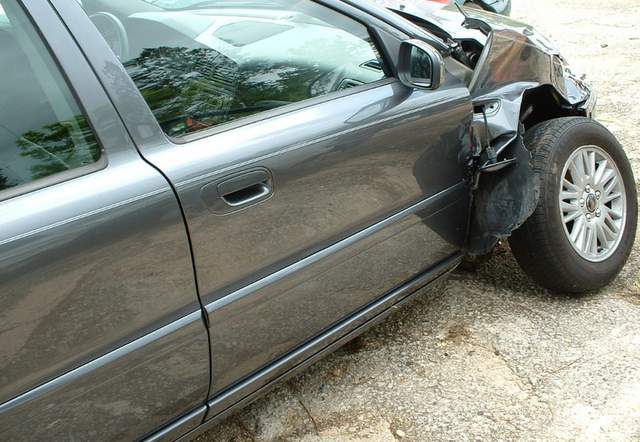
The at fault driver was uninsured. The passenger was injured. She had a shoulder injury (a rotator cuff tear).
She had surgery to fix it. My client made a UM claim under her own policy, and her friend’s UM policy.
We settled for $130,000. This settlement is before deduction for attorney’s fees and expenses.
Most cases result in a lower recovery. It should not be assumed that your case will have as beneficial a result.
My client’s rate should not increase from that accident. She was a passenger. She was not at fault.
The insurer cannot legally fail to renew her because she did not have 3 accidents in the prior 3 year period.
Even if she did, the big settlement ($147,000) significantly outweighs paying a few more bucks for car insurance.
Again, there are 66 or so Florida car insurers to choose from.
Why You Shouldn’t Worry About Making a Claim
It is much easier to get car insurance for a reasonable price in Florida than it is to get homeowner’s insurance.
You can easily find another car insurance company. They all want your business. That is why they spend BILLIONS of dollars advertising.
They spend so much money on ads that you probably know some of their commercials:
GEICO’S caveman or pig, Jake from State Farm, Flo from Progressive and many others.
Did someone’s carelessness cause your injury in a Florida car crash or other type of accident?
I want to represent you!
My Miami law firm represents people injured anywhere in Florida in car accidents and many other types of accidents.
We want to represent you if you were hurt in an accident in Florida. If you were injured in another state but live in Florida, we may also be able to represent you.
Call Us Now!
Call us now at (888) 594-3577 to find out for FREE if we can represent you. We answer calls 24 hours a day, 7 days a week, 365 days a year.
No Fees or Costs if We Do Not Get You Money

We speak Spanish. We invite you to learn more about us.